Rethinking Return-to-Hitting: Why “Cleared to Swing” Isn’t Enough
One of the most common gaps I see in baseball rehab is how we manage the return to hitting framework following injury.
While return-to-throwing programs are now widely accepted and relatively standardized, return-to-hitting is often treated as an afterthought. Too often, an athlete is simply told they’re “cleared to hit” and sent back into full batting practice with little structure, guidance, or consideration of workload.
And then we’re surprised when symptoms flare up.
We need to do better. Our athletes deserve better. Our hope is that the athletes we care for listen to us when we provide recommendations on how to rehab their injuries. But if our advice is inaccurate to begin with we are setting them up for failure.
Hitting Is Not a Low-Stress Activity
There’s a persistent belief in baseball that hitting is “safer” than throwing. While the elbow and shoulder stresses may differ, hitting still places significant rotational, compressive, and shear forces through the trunk, hips, and upper extremity. Some stats to put the level of stress into perspective:
GRF with lead leg average 160-170% BW (Orishimo 2023)
Hips rotate at 714 deg/sec and Shoulders at 937 deg/sec
Angular speed of the bat reaches 1588 deg/sec with a linear velocity of 31 m/s
Trail arm reaches an extension velocity of 948 deg/sec
Hamstrings, glutes, obliques, triceps, spinal erectors activate at nearly 100% capacity if not more (Welch et al 1995)
If you think about all of that and apply it to a single session of:
High-volume tee work
Front toss
Machine velocity
Or live ABs
we’re talking about a substantial workload, especially for an athlete coming off injury or surgery.
The issue isn’t that hitting is bad.
The issue is that we don’t respect its dose.
The Current Problem With Return-to-Hitting
In many rehab settings, return-to-hitting looks something like this:
“Start with tee work”
“Progress to front toss”
“Then BP”
“Then live”
That progression sounds logical—but it’s missing something critical:
👉 Quantification
Without controlling volume, intensity, and frequency, this becomes less of a progression and more of a guessing game.
We would never tell a pitcher to “just start throwing again” without tracking throws, distance, or effort. Yet we routinely do exactly that with hitters.
A Workload-Informed Approach to Hitting
Instead of thinking about return-to-hitting as a checklist of drills, we need to think of it as a graded exposure problem.
That means accounting for:
Volume (number of swings)
Intensity (effort, bat speed, pitch speed)
Variability (tee vs toss vs machine vs live)
Frequency (days per week)
Each variable influences total workload—and each needs to be progressed intentionally.
This mirrors how we already approach:
Return to throwing
Return to sprinting
Return to jumping
Hitting shouldn’t be any different.
Introducing a Structured Return-to-Hitting Framework
Over the past several years, we’ve worked toward developing a return-to-hitting framework that mirrors what clinicians and coaches already trust on the throwing side.
The goal is simple:
Provide clear guardrails
Reduce symptom flare-ups
Improve communication between rehab, performance, and coaching staff
Give athletes confidence in the process
Rather than asking, “Can he hit yet?”
We should be asking, “What level of hitting workload is he prepared for today?”
Click here to view each progression that we created.
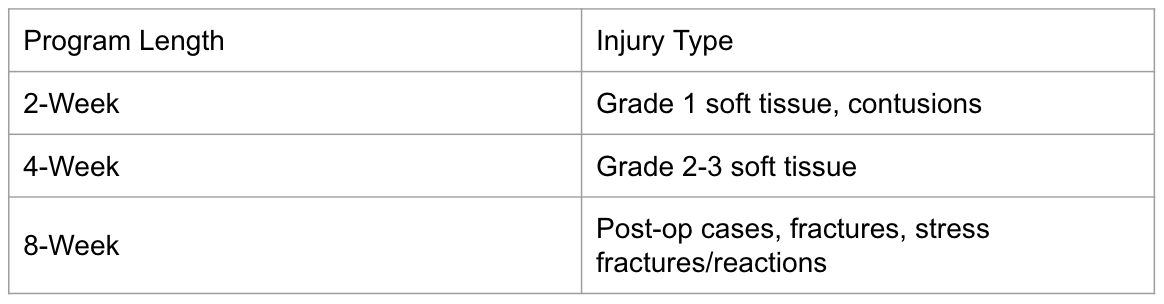
Different progressions based on injury type/severity
Why This Matters for Clinicians and Coaches
When return-to-hitting isn’t structured:
Rehab timelines become unpredictable
Setbacks feel random
Athletes lose trust in the process
When it is structured:
Symptoms become easier to manage
Progressions are clearer
Decisions are shared instead of subjective
This isn’t about slowing athletes down—it’s about keeping them moving forward.
Taking This Conversation Further at CSM
At this week’s Combined Sections Meeting (CSM), I’ll be joint Mike Reinold and Lenny Macrina to present a clinical commentary outlining a workload-informed return-to-hitting model designed specifically for baseball and softball athletes.
The presentation will cover:
Why traditional hitting progressions fall short
How hitting workload compares to throwing workload
Practical ways to structure hitting volume and intensity
How clinicians can integrate this model into real-world rehab settings
If you work with rotational athletes—and especially baseball hitters—this is a conversation worth having.
Because “cleared to hit” shouldn’t be the end of the discussion.
It should be the beginning of a well-planned progression.
