Velocity vs. Vulnerability: When the Risk of Weighted Balls is Actually Worth It
Weighted balls might be the most polarizing tool in modern baseball development. Walk into almost any baseball facility and you’ll see athletes — some who haven’t even reached high school — launching overweight and underweight balls into nets chasing higher readings on the radar gun. At the same time, sports medicine clinics across the country are seeing a steady rise in UCL injuries chronic elbow pain.
So which is it? Are weighted balls a performance breakthrough or a fast track to injury?
Like most things in human performance:
They work.
And they carry risk.
The real question isn’t whether weighted balls increase velocity. It’s whether the athlete has the capacity to tolerate what they demand.
Why Weighted Balls Increase Velocity
To understand the debate, you have to understand the mechanism.
Weighted ball programs manipulate mass to change force production and velocity.
Overload balls (heavier than a 5oz baseball): Heavier balls increase force requirements. The body must generate more torque at the shoulder and elbow to move the mass.
This can increase:
Force production capacity
Rate of force development
Motor unit recruitment
Underload balls (lighter than 5oz baseball): Lighter balls allow the arm to move faster than baseline.
This trains:
Arm speed
Neuromuscular timing
Velocity-specific coordination
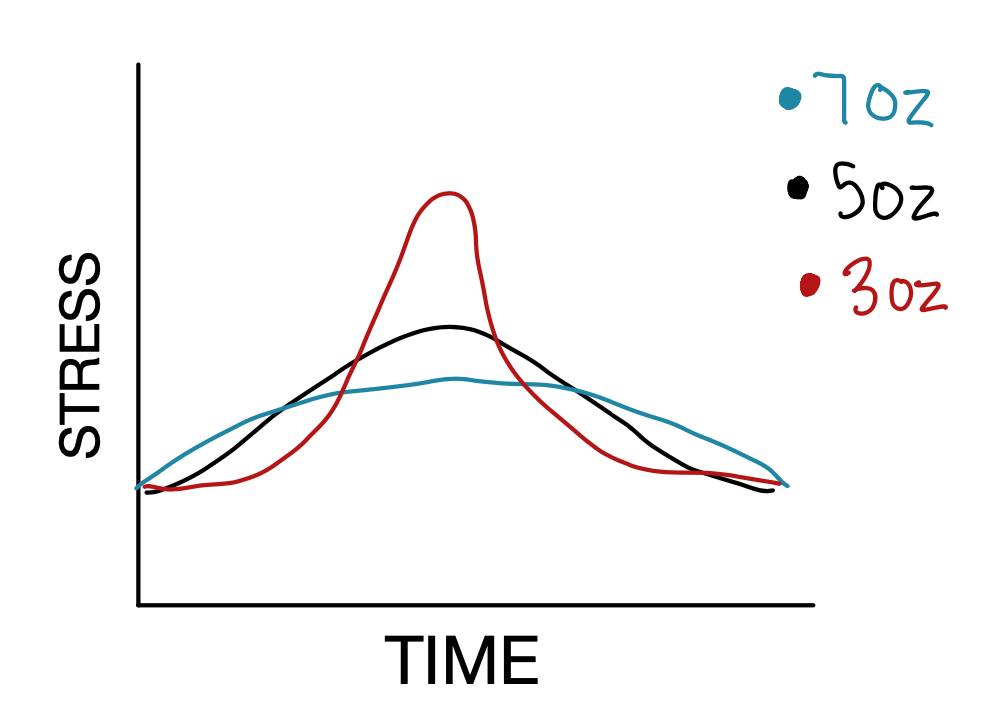
This graph depicts the amount of torque placed on the elbow depending on which ball weight is thrown. Higher peak torques are seen with underload balls.
The nervous system adapts quickly to velocity exposure. That’s why athletes often see velo jumps in 6–8 weeks. But this is just the tip of the iceburg.
The Layback Effect: The Real Driver of Velo Gains
One of the most consistent findings in weighted ball research is this:
Weighted ball programs increase shoulder external rotation (layback).
During the late cocking phase of throwing, the shoulder rapidly externally rotates — often reaching 160–180° in high-level throwers. This position stores elastic energy in the anterior shoulder structures and the elbow.
When weighted balls are introduced — especially lighter underload balls — athletes often demonstrate:
Increased maximal external rotation
Greater layback tolerance
Earlier and more aggressive arm acceleration
Why does this happen?
The nervous system adapts to higher velocities. As the arm moves faster, athletes begin to access greater external rotation angles. High-intensity throwing repeatedly exposes the shoulder to extreme ER angles. Over time, passive ER often increases.
Increased external rotation increases the torque placed on the anterior capsule of the shoulder and the medial stabilizers of the elbow (UCL). This increased ROM is essentaily enhancing the stretch-shortening cycle of the throwing motion.
More stored elastic energy → greater internal rotation velocity → higher ball velocity.
This is one of the primary reasons weighted balls can produce noticeable velo gains.
But here’s the part that matters: Layback is not free. It is velocity purchased with joint stress.
The Physiological Cost
When layback increases, joint torque increases. Research consistently demonstrates increases in:
Elbow varus torque
Shoulder external rotation stress
Glenohumeral distraction force
The exact mechanism that helps velocity improve — increased ER and higher force production — is the same mechanism that increases ligament stress. And here’s the critical issue:
Muscle and nervous system adapt quickly. Connective tissue adapts slowly.
You can gain 2–4 mph before your UCL, labrum, and capsule have meaningfully increased their tolerance. That mismatch is where injury risk lives. Weighted balls are not inherently dangerous. But they are a load amplifier. And amplifying load without sufficient capacity is how tissues fail.
Before even discussing weighted balls, we should ask:
Is the athlete skeletally mature?
Have they exhausted all options in the gym to achieve peak strength and power?
Is their total arc of motion appropriate?
Is their workload currently well managed?
If those boxes are not checked, weighted balls are not the solution.
Who Might Be Appropriate Candidates?
Weighted balls are not general developmental tools. They are specific interventions for specific profiles.
1. The Skeletally Mature Athlete
Growth plates must be closed. Exposing an open physis to extreme valgus stress is unnecessary and risky. Biological maturity matters more than chronological age. To add to this, someone who is not skeletally mature has absolutely not exhausted all options in the gym to improve their physical and athletic performance. We know that athletes can improve pitch and exit velocity by becoming stronger and more powerful in the gym. This must be explored first prior to experimenting with weighted balls.
For those individuals who are well versed in the gym and skeletally mature, weighted balls may be an option if velocity is still not improving.
2. The Hypomobile Thrower
A true hypomobile athlete with restricted total rotational motion may benefit from carefully dosed range exposure. As stated previously, we know that weighted balls can increase layback (ER). In this instance, someone who has a low total rotational arc may benefit from a slight increase in ROM so long as they have the strength to support it.
3. The Mechanically Efficient Athlete
Weighted balls do not fix:
Late arm
Early trunk rotation
Poor scapular control
Inconsistent timing
They magnify what is already present. If mechanics are flawed, adding load simply magnifies stress. The athlete with excellent mechanics may be able to handle the new stress of adding weighted balls to their program.
4. The Athlete in a Performance Window
This probably the candidate where weighted balls make the most sense.
The high school/college senior.
The minor leaguer.
At that level, the risk-reward calculation changes. This is the point where we are going to accept the injury risk associated with weighted balls because if this athlete doesn’t gain a few MPH then their career is likely over. That decision should involve the athlete, the coach, and the medical team. It is a risk, but one that we are willing to take to get to the next level.
Who Should Avoid Weighted Balls?
1. Youth Athletes
Like stated above, velocity development should come from:
General strength
Rotational power
Mechanical efficiency
Gradual throwing exposure
Not aggressive overload.
2. Athletes With Prior UCL or Labral Injury
If tissue tolerance has already been exceeded once, increasing torque should not be the first strategy.
3. Hypermobile Athletes
These athletes already live near their passive end ranges. Adding more ER without improving strength and control increases instability risk. Their priority is strength to gain stability.
If You Choose to Use Them
If an athlete meets criteria and proceeds, structure matters.
1. Evaluate First
Assess:
ROM profile
Strength
Power
Workload history
2. Control Volume Aggressively
More is not better. Weighted ball sessions should not resemble conditioning workouts. Throws of this magnitude with the injury implications associated with them need to be prescribed appropriately. We know that during a 6 week weighted ball program, throwing roughly 30 throws per session 3x/wk generated improvements in velocity via increased layback (Reinold et al 2018). However, the injury rate in this group was 24%. That is a staggering number. Based on this data, I’m not sure we should be reaching the same number of throws seen in this study.
3. Manipulate One Variable at a Time
You can adjust:
Load
Velocity
Volume
Frequency
Do not increase them simultaneously.
4. Strength Training Is Mandatory
If the posterior shoulder, trunk, and lower body are not strong enough to accept force, the elbow absorbs it. Velocity is a full-body output. Chasing it with the arm alone is how players get hurt.
The Bigger Picture
Weighted balls are not magic. They are not evil. They are a high-intensity stimulus. And high-intensity stimuli require high capacity.
For most developing athletes, the biggest velocity gains still come from:
Getting stronger
Moving better
Managing workload intelligently
Letting the body mature
Weighted balls may help a small percentage of athletes at the right stage.
For everyone else, the juice often isn’t worth the squeeze. Velocity is earned through capacity. Not shortcuts.
