Weekly Workload Management in Baseball: What Most In-Season Throwing Schedules Get Wrong
One of the most common conversations I have with baseball players during the season starts the same way:
“I don’t think I’m throwing that much.”
When we actually break down their week—live innings, bullpen sessions, long toss, catch play, lifting, and recovery work—it becomes clear that most athletes don’t truly understand what their weekly workload looks like. More importantly, they don’t understand how that workload is distributed.
This lack of clarity is one of the biggest drivers of in-season arm pain, fatigue, and performance drop-off that I see in practice. It’s rarely about a single bad throw. More often, it’s about how acute workload stacks on top of what the athlete has—or hasn’t—been prepared for.
Why Weekly Structure Matters More Than Any Single Throw
Baseball injuries are often framed as volume problems—too many throws, too many innings, too many pitches. While total volume matters, how that volume is organized across the week may be even more important.
Research in baseball and other high-demand sports consistently shows that:
Sudden spikes in workload increase injury risk
Fatigue alters mechanics and tissue loading
CNS stress accumulates faster than most athletes realize
In-season, the goal isn’t to avoid stress. The goal is to apply stress intentionally, allow recovery, and repeat that pattern consistently.
When everything becomes a “medium-hard” day, nothing actually recovers.
The Problem With Most In-Season Throwing Plans
Most in-season throwing schedules fail for one of three reasons:
Every day looks the same
Catch play drifts longer, intent creeps up, and before long every day becomes moderately stressful.High-stress days aren’t respected
Live outings, bullpens, and higher-intent throwing like long toss are often stacked too closely together or far too frequent.Strength and throwing aren’t coordinated
Lifting and arm care are added randomly instead of supporting the throwing workload.
The result is a constant state of low-grade fatigue—never sore enough to shut things down, but never fresh enough to perform at a high level.
A Better Way to Think About Weekly Workload: CNS Stress
Rather than organizing a week solely by pitch counts or distance, I prefer to think in terms of central nervous system (CNS) demand.
In simple terms:
High CNS days: live outings, high-intent bullpens
Medium CNS days: catch play with intent, structured long toss, moderate volume
Low CNS days: light catch, movement work
This framework allows us to:
Stack stress when appropriate
Protect recovery windows
Maintain performance deeper into the season
The goal is not to eliminate high days—it’s to separate them intelligently.
If there is anything I want you to take away from what you’re about to read, it’s that our ultimate goal is to be ready to go for the next time we are throwing competitively. Let me say that again: the entire purpose of weekly structure is to prepare the athlete to peak when they step back on the mound to compete.
What a 7-Day In-Season Week Should Look Like (HS & College Pitchers)
For high school and college pitchers, a 7-day rotation is often the most realistic structure due to schedules, recovery capacity, and game frequency.
In the attached 7-day schedule, the week is anchored around throwing in game. Again - I know I sound like a broken record - the rest of the week is built to facilitate peak performance on this day.
Key features of the 7-day model:
Two true high CNS days (Live and BP)
Clear separation between medium and light throwing days
Lifting and arm care placed to support performance, not impede it
Importantly, not every throwing day is treated the same. A light day is truly light. A medium day has purpose but limits. High days are respected as high.
This structure allows athletes to:
Recover from game stress
Maintain arm speed and feel
Avoid compounding fatigue across the week
Below is an example of a starting pitcher throwing on a 5 and 7 day schedule. Granted, not every program can be a one-size-fits-all, but this should provide a sufficient representation of what a weekly schedule should look like.

What a 5-Day In-Season Week Should Look Like (MLB & MiLB Pitchers)
Professional pitchers operate under different constraints—more frequent games, deeper bullpens, and higher absolute workloads.
For many MLB and MiLB pitchers, a 5-day cycle is more appropriate.
In the attached 5-day schedule:
Live days are more frequent
Volume is distributed more evenly
Light days are essential for recovery between outings
The biggest mistake I see at this level is assuming that because an athlete is “used to it,” they don’t need structure. In reality, structure becomes more important as workload increases.
Even at the highest levels, unmanaged weekly stress leads to breakdown.
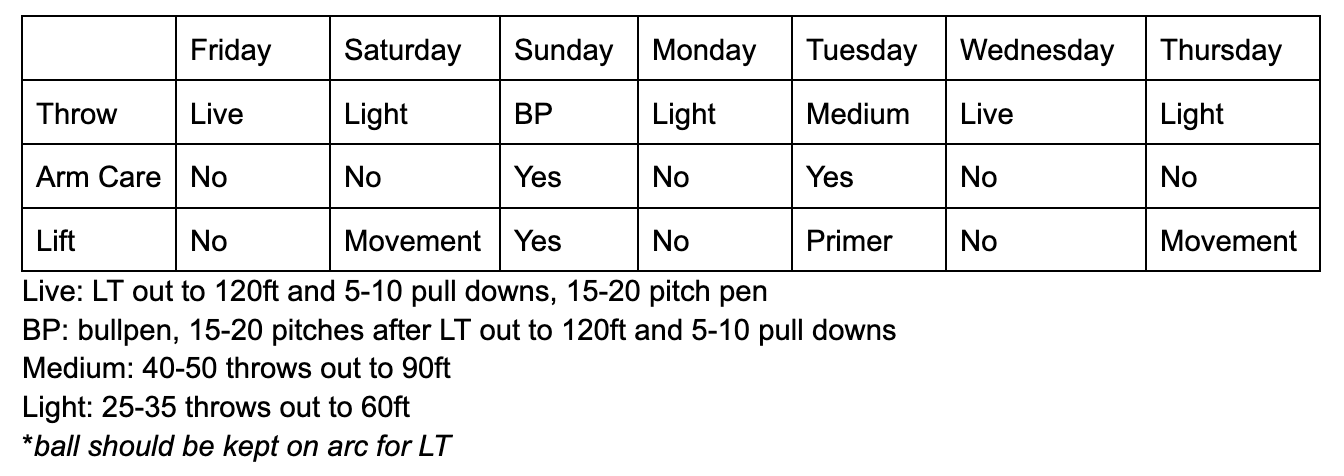
How Throwing Intensity Actually Breaks Down
To avoid confusion, here’s how I typically define throwing intensity in-season:
Light: 20–30 throws out to ~60 feet
Medium: 40–50 throws out to ~90 feet
Bullpen: 15–20 pitches after building out to 120 feet with a few pull downs
Live: Game or simulated game conditions
These definitions matter because athletes often underestimate how stressful “just playing catch” can become when we don’t monitor for intensity. As a rule of thumb, I let distance dictate the intensity for most throwing days. And if you’re reading this and saying “120 feet isn’t long toss, I go to 300ft+” - boy do we need to have a serious conversation. But let’s save that for a future date.
Where Strength Training and Arm Care Fit In
One of the most overlooked aspects of weekly workload management is where lifting and arm care live.
In both schedules:
Heavier lifts are paired with medium or higher CNS days
Light movement days follow live days with the goal of getting the blood flowing and restoring ROM
Priming sessions prepare the CNS for high-intent throwing to follow the next day
Arm care is used strategically, not automatically every day
Arm care is a loosely used term with a hundred different meanings. We know that cuff strength is lost in-season - our best strategy is to try to mitigate the loss of strength by supplying the cuff with 2 strength related sessions per week. And let’s make this clear - arm care in my eyes looks like loading the cuff with heavy dumbbells. 2 sets of 10 reps. Is it as fancy as what you see on instagram? No. But it is absolutely the most effective way to retain strength (and build it in the off-season.)
What the Research Tells Us (And What It Doesn’t)
While there’s no single study that outlines a perfect weekly throwing schedule, the literature consistently supports:
Gradual workload progression
Avoidance of acute workload spikes
The relationship between fatigue and injury risk
Studies examining acute-to-chronic workload ratios suggest that how quickly workload changes may be more predictive of injury than total volume alone.
This reinforces the idea that weekly organization—not just pitch counts—matters.
Practical Takeaways
If you take nothing else from this discussion, remember this:
Every throwing day should have a clear purpose
Two clearly defined high-stress days are far more manageable than seven consecutive ‘medium’ days.
Strength training should support, not compete with, throwing
Weekly workload matters more than any single session
Final Thoughts
In-season workload management doesn’t need to be complicated—but it does need to be intentional.
I’ll take the time when I’m working with an athlete to walk over to the white board and map out a weekly schedule based on their individual needs. These programs need to be individualized - not everyone is going to succeed on the same plan. When athletes understand what their week is supposed to look like, they stop guessing, stop overdoing it, and start recovering better. Over the course of a long season, that clarity can be the difference between staying available and slowly breaking down.
The best ability in baseball is availability—and availability starts with weekly structure.
